0
0
 0
0
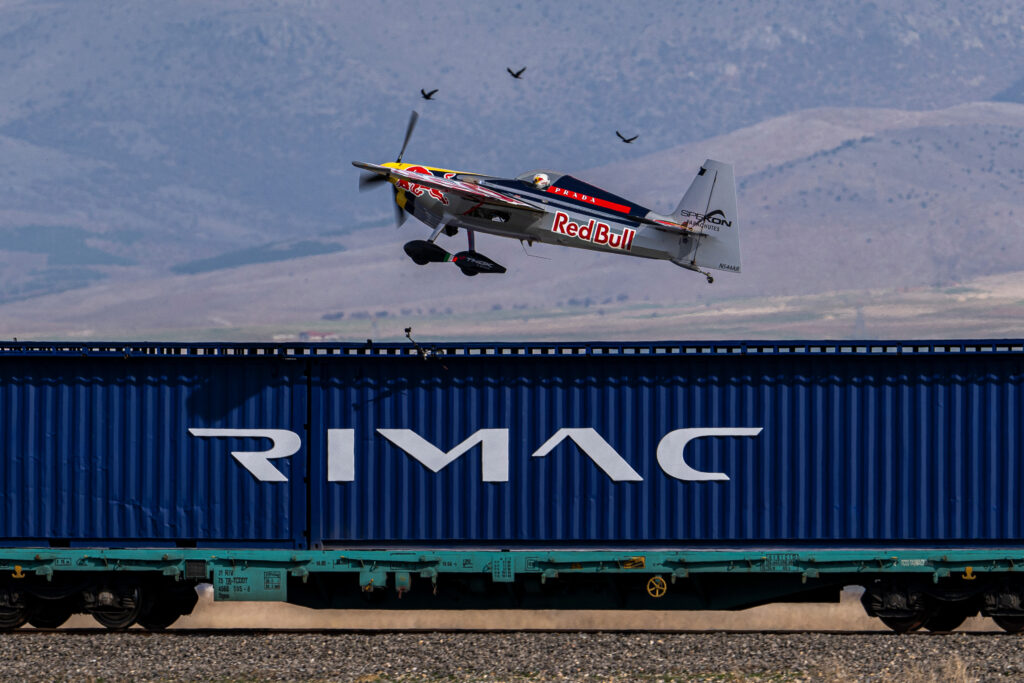
AFYONKARAHİSAR, TÜRKİYE – 16 February 2026: Red Bull athlete Dario Costa (Italy) has made aviation history with a world-first dual manoeuvre in Afyonkarahisar, Türkiye, landing his race aircraft on a moving cargo train before lifting off again in a vertical pull from the same container.
The Italian pilot executed a blind landing on a 2.5km track in heavy turbulence and shifting airspeeds, with only centimetres of margin for error, and a 50-second window to make contact and take off.
The aircraft reduced to a near-stall airspeed of 87km/h (47 knots) to match the train travelling at its maximum operational speed of 120km/h (65 knots).
Known as Train Landing, the project follows months of engineering analysis, simulation work, flight preparation, and safety protocols, combining synchronised speed matching, aerodynamic control, cognitive training, and millimetre-accurate timing.
Key Facts
- Project: Train Landing – landing and taking off from a moving train
- Pilot: Dario Costa (Italy, 44) – Red Bull athlete
- Aircraft: Zivko Edge 540 aircraft
- Date: 15 February 2026
- Location: Afyonkarahisar, Türkiye
- Landing speed: 120km/h (65 knots) for approach, down to 87km/h (47 knots)
- Usual cruising speed: 370km/h (200 knots)
- Usual landing speed: 148km/h (80 knots)
- Wind direction: 5 km/h (3 knots) tailwind
- Track length: 2.5km
- Maximum 50 seconds to approach touch down, land, and take off
Route and Performance Overview
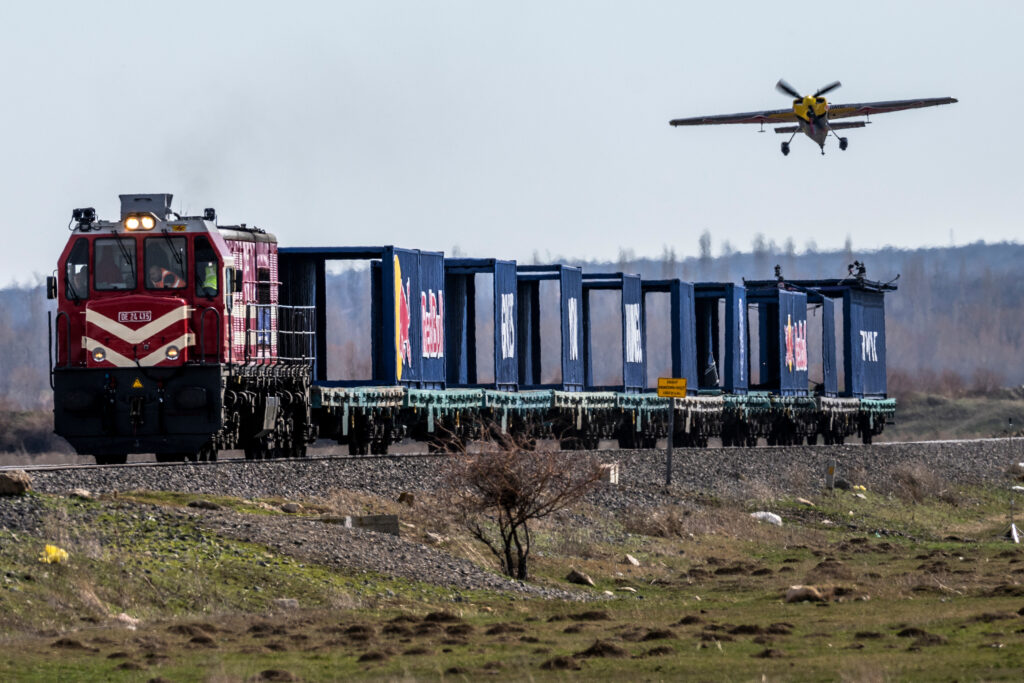
- Approach Phase – The train, travelling at 120km/h (65 knots), remained visible at a 45-degree angle until 200m before the final blind approach over the target container.
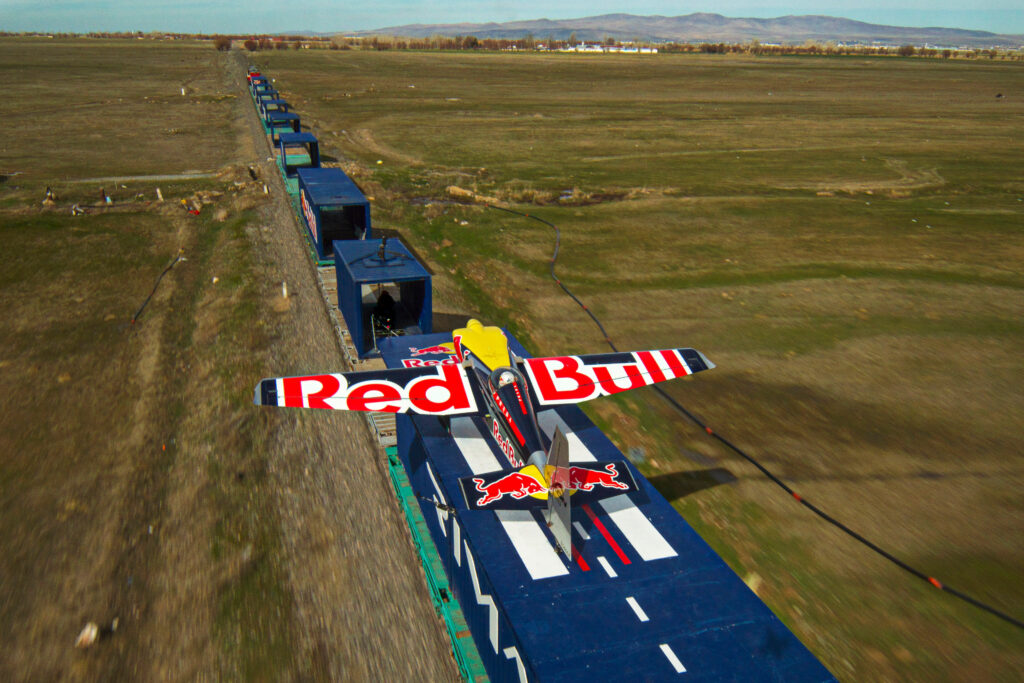
- Landing – All three wheels made contact with the 9th cargo container; longitudinal and lateral alignment maintained despite airflow turbulence and a drastic reduction in airspeed from 120km/h (65 knots) to 87km/h (47 knots).
- Stabilisation – Continuous aerodynamic correction amid turbulence generated by the moving train, amid near-minimum airspeed.
- Take-off – Controlled acceleration and lift-off into an immediate vertical climb from the same container, completing the world-first sequence.
Technical and Aerodynamic Complexity
Landing on a moving runway requires exact speed parity. In this case, Costa aligned the Zivko Edge 540 with the 9th and final container of the cargo train travelling at its full operational speed of 120km/h (65 knots). Meanwhile, he reduced the aircraft to its minimum controllable airspeed of 87km/h (47 knots).
During the manoeuvre, the train created significant wake turbulence and unstable airflow over the container, resulting in continuous adjustments to maintain longitudinal and lateral control. This decreased the airspeed over the container by 33km/h (18 knots), increasing the complexity of the feat.
Approaching from south-east to north-west, the aircraft synchronised precisely with the train’s direction and velocity. Even a minor mismatch of a few centimetres could have caused longitudinal or lateral overshoot from the narrow container surface.
Because of the aircraft’s design, attitude (that is, the position of the aircraft’s nose and wings with respect to the horizon – approximately 8 degree pitch-up), and the train’s dimension, the platform remained outside Costa’s field of vision throughout the approach. The pilot relied solely on cognitive training and skill to achieve alignment.
Aircraft Specifications and Optimisation
- Aircraft type: Zivko Edge 540 – race and stunt aircraft, mid-wing, single-seat, piston-engine, constructed from steel and carbon composite
- Performance: 400-horsepower engine
- Dimensions: 7.5m wingspan, 7m length, landing gear width 1.70m
- Modifications: No major modifications were made, but the aircraft setup was optimised for lower-speed flight using two custom strakes designed with Engineer Pietro Terzi and six (3+3) small vortex generators designed with Engineer Hartmut Siegmann (“Siggi”)
Innovative Preparation and Testing
Ample aerodynamic studies were conducted to estimate the precise turbulence and airspeed reduction caused by the train.
Costa underwent cognitive preparation at the Red Bull Athlete Performance Centre in Thalgau, which included specialised “time–movement–anticipation” training, which proved critical to executing the blind landing.
Prior to the feat in Türkiye, a three-day moving-platform scenario was tested in Pula, Croatia, in collaboration with Rimac Automobili. Using their all-electric Nevera R hypercar as a precision-moving platform reference, Costa refined alignment and reaction timing.
Inspired by Türkiye: From Tunnel Pass to Train Landing
Following Costa’s 2021 world-first project in Türkiye, Tunnel Pass - in which he flew through two highway tunnels outside Istanbul - the Italian pilot returned to the country to explore the feasibility of a new aviation concept. During that visit, he encountered a nostalgic passenger train in Kars, in the northeast of Türkiye, prompting him to consider unconventional landing concepts beyond static environments.
Extensive analyses and field studies ultimately identified Afyonkarahisar as the optimal location due to its railway infrastructure, operational conditions, and geographic characteristics, enabling the project to be executed in a controlled and secure environment.
Quotes
Dario Costa, Red Bull Athlete: “Train Landing was one of the most challenging and demanding projects of my career. There were so many variables to measure, but the greatest test was learning to land blind on a very small moving runway – relying only on cognitive and flying skills.
Despite the difficulty, it was a great experience. For the first time, an aircraft successfully interacted with a moving train, bringing together the oldest motorised transportation with the newest. It was a complex project that required precision, teamwork, and trust – and I’m proud we executed it as planned.”
Filippo Barbero, Aviation Consultant: “The most critical aspect was the alignment with the train, so precision had to be absolute, and he achieved that. During a project like this, there’s no room for emotions – Dario is a true magician.”
Why It Matters
Executing a landing and take-off on a moving container represents a step change in applied aerodynamics and pilot skills. Completing the feat at full operational train speed and the lowest aircraft speed demonstrates how data-driven preparation and precision flying can expand the boundaries of controlled flight in non-traditional environments.
About the Athlete
Dario Costa is an Italian pilot and Red Bull athlete recognised for high-precision flying and technically complex aviation projects that combine engineering planning with elite pilot performance. Across his career, Costa has delivered more than 20 aviation world-firsts, including Tunnel Pass and the legendary Streif course preview, among others. He is the first and only Italian to qualify, compete and win in the Red Bull Air Race, and the first and only Italian - as well as the youngest ever recipient - to receive the prestigious Bob Hoover Freedom of Flight Award. He currently holds five Guinness World Records.
Learn More
- Read more about Dario Costa’s record-setting Train Landing feat
- Discover Costa’s flight over Kitzbühel’s legendary Streif
- Watch: Relive Dario Costa’s world-first Istanbul tunnel flight in Tunnel Pass